Why leaders are being asked to hold more than they have been developed to carry
Sit with leaders long enough and a quieter pattern begins to emerge.
Not always in the formal conversation. Not always in the language of strategy, performance or transformation. But just beneath it, many leaders are carrying the same question:
How do I keep meeting what is being asked of me without losing clarity, energy or myself?
The work of leadership has become heavier. Not only because there is more to do, but because there is more to hold. More uncertainty. More emotional pressure. More complexity. More expectation. More change. And often, less time to make sense of any of it.
This is what we are seeing in many leadership conversations: capable people trying to stay steady inside conditions that keep shifting around them.
External research reflects a similar pattern.
According to McKinsey & Company, 75% of executives say their organisations are experiencing more disruption today than three years ago, driven by technological change, geopolitical uncertainty and economic volatility.
The World Economic Forum’s Future of Jobs Report estimates that 44% of workers’ core skills will change within five years, largely due to automation, AI and digital transformation.
Gallup’s State of the Global Workplace report found that 44% of managers report experiencing daily stress.
These figures are not the story by themselves. But they help name something many leaders already recognise in their own experience: the demands of leadership have expanded faster than the capacity many leaders have been supported to develop.
This is the leadership capacity gap.
Not simply a gap in skill, knowledge or competence. A gap between what leadership now asks of a person and the inner, relational and systemic capacity available to meet it.
The conditions leaders are holding have changed
Many leaders no longer experience their work as a sequence of problems to solve.
They are often operating in conditions that shift while they are still trying to understand them. One decision opens three more. A change in one part of the organisation creates pressure somewhere else. What looked clear in the morning feels different by the end of the day.
Researchers often describe this terrain as VUCA: volatile, uncertain, complex and ambiguous. More recently, the term BANI has been used to describe conditions that feel brittle, anxious, non-linear and incomprehensible.
The labels matter less than the lived experience they point to.
Leaders are no longer working in relatively stable systems where planning and optimisation are enough. They are continually interpreting changing conditions and responding in real time.
That asks for a different kind of leadership capacity.
It asks for the ability to pause when the system is moving quickly. To discern what matters when there is too much noise. To stay in relationship when pressure rises. To hold uncertainty without rushing too quickly to false certainty.
These are not only technical capabilities. They are human capacities.
When the role expands faster than the support around it
What we often see is that many leaders are not struggling because they are unwilling, unskilled or undercommitted.
They are struggling because the role itself has expanded.
Leaders are expected to guide transformation, manage distributed teams, respond to rapid technological change, develop people, sustain engagement, protect wellbeing, hold culture and deliver results. Often, all at once.
Deloitte’s Global Human Capital Trends research describes managers as increasingly expected to act as operational leaders, culture carriers, talent developers and change agents simultaneously.
This reflects something many leaders experience directly: the role has become wider, more emotionally demanding and more complex.
Yet the support around leaders has not always expanded with it.
The result is often a quiet form of overload. Capable people continue to function. They keep moving, keep deciding, keep responding, keep holding the needs of others. But the space to pause, reflect and make sense of what is happening becomes thinner.
Over time, this begins to shape how leaders show up.
They may become more reactive. More controlling. More avoidant. Less able to listen. Less able to see the wider system. Not because they do not care, but because sustained pressure narrows the space from which they lead.
The pipeline is telling us something
One of the clearest signals may be coming from those who are not yet in senior leadership.
According to Deloitte’s Millennial and Gen Z Survey, more than 50% of younger professionals say they do not aspire to leadership roles, citing stress, accountability and work-life imbalance as primary reasons.
This matters.
When emerging leaders look at leadership and decide it is not a life they want, organisations face more than a succession challenge. They face a meaning challenge.
What is leadership starting to represent?
If leadership appears to mean more pressure, less balance, greater exposure and limited support, it becomes harder to ask the next generation to step forward with energy and commitment.
At the same time, leadership remains one of the strongest influences on organisational life. Gallup research consistently shows that managers account for around 70% of the variance in team engagement.
So the tension is clear.
Leadership deeply affects motivation, wellbeing, performance and retention. Yet for many people, leadership is beginning to look less attractive and less sustainable.
That is a serious signal for organisations. It suggests that leadership development cannot only prepare people to perform the role. It also has to help make the role more humanly sustainable.

Technology is changing the context leaders must hold
Technology is changing work quickly. But what we are seeing is that it does not make leadership less human. In many cases, it makes the human work of leadership more important.
As organisations adopt AI, automation and new digital systems, leaders are often left holding the uncertainty that comes with that change: anxiety about roles, questions of trust, shifting skills, ethical choices and the need to help people adapt while the ground is still moving.
The World Economic Forum reports that nearly 43% of companies expect to reduce their workforce due to technological integration, while demand for high-level cognitive and interpersonal skills continues to rise.
This is why technology belongs in the conversation about leadership capacity. It is not only changing tasks. It is changing the emotional, relational and ethical context in which leaders must lead.
The capacities required here are deeply human: judgement, empathy, adaptability, discernment and the ability to create clarity when people feel uncertain.
These are not simply technical skills to be installed. They are developmental capacities that grow through experience, reflection, practice and relationship.
When knowing more does not help leaders hold more
Many leaders have already had a great deal of development.
They have learned communication models. Performance frameworks. Strategy tools. Coaching techniques. Change methods. They know many of the things good leaders are supposed to do.
And yet, many still arrive at a quieter recognition: the hardest part of leading is not covered by knowing the model.
It is what happens under pressure.
Research from McKinsey suggests that only 11% of executives strongly agree that their leadership development programmes deliver meaningful results.
This does not mean leadership development is unimportant. It suggests that much leadership development may still be focused on the wrong layer.
A great deal of development focuses on what leaders do: how they communicate, manage, align, delegate, execute and give feedback.
These are important.
But beneath the visible behaviour is another layer: how a leader perceives, interprets and responds.
- How do they read complexity?
- How do they relate to uncertainty?
- How do they regulate themselves under pressure?
- How do they hold competing needs?
- How do they stay connected to purpose when the system becomes noisy?
- How do they make wise choices when no option is clean?
This is where leadership development often needs to go deeper.
What happens beneath the surface under pressure
Under pressure, leaders do not simply apply knowledge.
They respond from patterns.
Some move into control. Some move into speed. Some withdraw. Some try to hold everything alone. Some simplify complexity too quickly. Some avoid the conversation that most needs to happen.
This is not a moral failing. It is human.
Neuroscience helps explain why this matters. Research into stress and decision-making shows that when people experience sustained stress or cognitive overload, the prefrontal cortex, which supports planning, emotional regulation, strategic thinking and complex decision-making, becomes less active. More reactive parts of the brain, particularly the amygdala, can become more dominant.

In practical terms, this can make leaders faster to react and less able to reflect. It can reduce the capacity to hold multiple perspectives, regulate emotion and think systemically.
This matters because these are exactly the capacities leaders need most in complex environments.
Under pressure, leaders can lose access to the very capacities they most need: reflection, regulation and perspective.
The same field also points to what can help. Reflective practice supports meta-cognition: the ability to observe and regulate one’s own thinking. Neuroplasticity shows that the brain can reorganise and strengthen pathways through repeated experience and practice.
In other words, leaders can develop the capacity to pause, notice, regulate and respond with greater intention.
But this does not happen through information alone.
The deeper work of development
If leadership capacity depends partly on how leaders perceive and respond in real situations, then development has to be designed differently.
It cannot only transfer information. It must create the conditions for leaders to work with themselves in context.
This is where experiential development becomes important.
Adult learning theory, including David Kolb’s experiential learning cycle, describes learning as a movement through experience, reflection, conceptual understanding and active experimentation.
The Four Stages of Learning
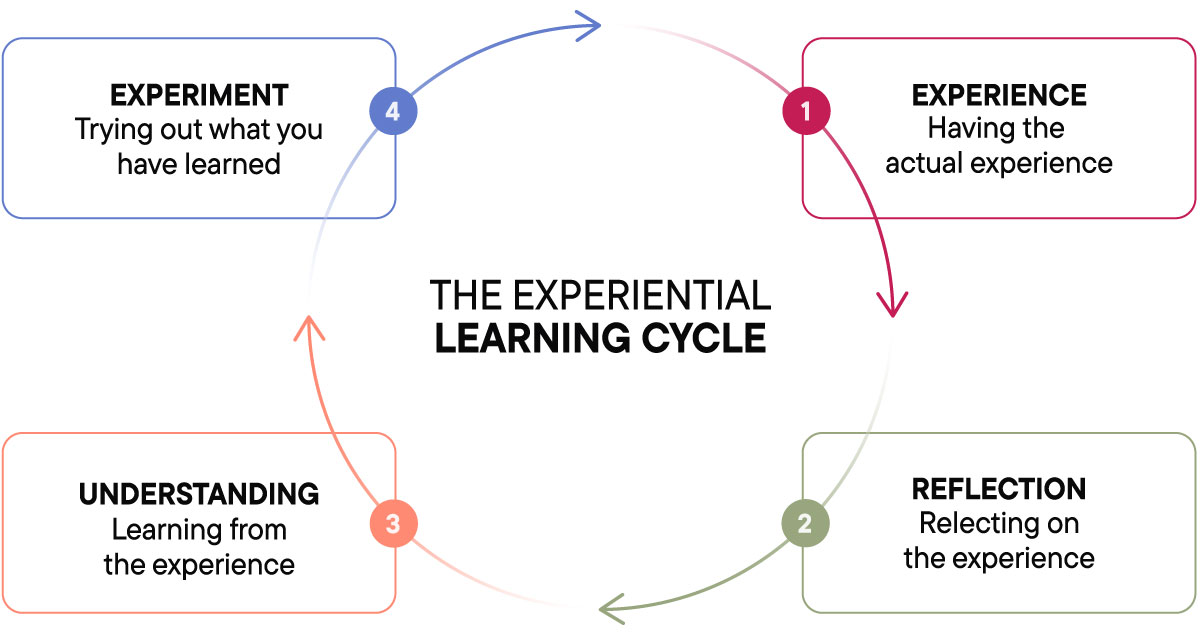
In leadership terms, this means development becomes more powerful when leaders are able to work with real challenges, reflect on their responses, understand what is shaping them and experiment with new ways of acting.
Research in organisational development has linked experiential leadership programmes with improvements in emotional intelligence, adaptive decision-making and collaborative leadership. These are especially important in environments marked by uncertainty and complexity.
This is also why reflective dialogue matters.
When leaders step outside the immediate pressure of their role, even briefly, they can begin to see patterns that are difficult to notice while they are inside them. They can examine their assumptions, values, reactions and motivations. They can hear how others make sense of complexity. They can begin to understand not only what they are doing, but who they are becoming as they lead.
That is where development becomes more than training.
It becomes a way of growing the person while developing the leader.
Leadership begins with self-leadership
At Companions for Leadership, this is one of the foundations of the work.
Leadership begins with self-leadership.
Not as self-focus. Not as personal development disconnected from organisational reality. But as the recognition that how a leader relates to themselves shapes how they relate to others, to pressure and to the wider system.
Self-leadership is the capacity to understand and work with one’s own perceptions, reactions and decisions.
In complex conditions, how a leader sees a situation often matters as much as what they do about it. When self-awareness is thin, complexity can be met with defensiveness, over-control or avoidance. As awareness deepens, leaders become more able to pause, interpret what is happening and respond with intention.
This is where the inner dimension of leadership becomes practical.
- It affects conversations.
- It affects judgement.
- It affects trust.
- It affects energy.
- It affects the quality of decisions.
- It affects the leader’s ability to stay present when the system is under strain.

From leadership competence to leadership wisdom
The leadership capacity gap will not be closed by competence alone.
Competence matters. Skills, tools and frameworks all have their place. But the conditions leaders now face ask for something more integrated.
At Companions for Leadership, leadership wisdom is understood as the capacity to meet complexity with presence, discernment and agency. It is the ability to sense what is happening, access inner resources and respond with choice rather than reaction.
It brings together three dimensions:
The inner dimension: how leaders relate to themselves
The relational dimension: how leaders engage with others
The systemic dimension: how leaders read and respond to the wider dynamics around them
When these dimensions begin to align, leaders are better able to hold tension between competing priorities, navigate ambiguity without becoming paralysed, balance care for people with the courage to act and integrate authenticity with responsibility.
This is not about having an answer for every problem.
It is about developing the discernment to meet reality more clearly.
Closing the leadership capacity gap
The conditions creating the leadership capacity gap are not going away.
Technological change will continue. Geopolitical uncertainty will continue. Workforce expectations will continue to shift. Organisational complexity will continue to deepen.
The question is not whether leaders need development.
The question is whether development is deep enough for what leadership now requires.
If leaders are being asked to hold more complexity, they need more than new tools. They need more space for reflection, more capacity for self-leadership, more support to work with pressure and more opportunity to grow in relation to the real situations they face.
Because the future will not only belong to organisations with the strongest strategy, the most advanced technology or the most efficient operating model.
It will belong to organisations that develop leaders who can meet complexity with clarity, resilience, humanity and wisdom.
In the end, organisations can only transform as far as their leaders are able to grow.